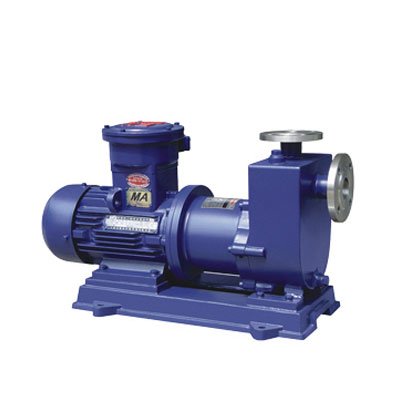
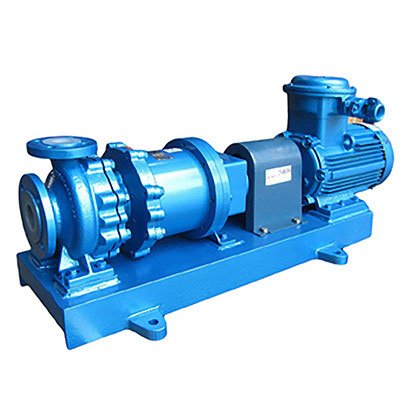
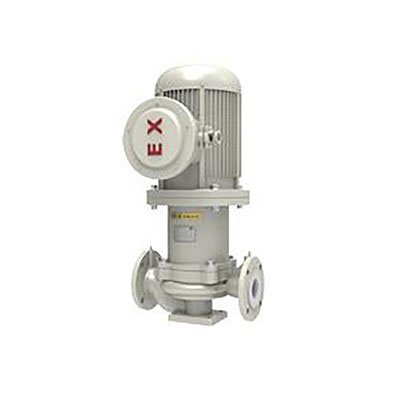
ZCQ Type Self-Priming Magnetic Drive Pump (hereinafter referred to as the self-priming pump)
This pump adopts static seals instead of dynamic seals, keeping the wetted parts of the pump in a fully sealed state, which completely eliminates the common problems of leakage, seepage, dripping and running fluid that are unavoidable with mechanical seals in other pumps.The pump body and wetted components are made of corrosion-resistant materials such as stainless steel, alumina ceramic, PTFE and graphite.It inherits all functions of the CQ type magnetic drive pump and integrates self-priming performance. No bottom valve or priming water is needed, with a self-priming height of 4 meters.
Working Principle
The ZCQ self-priming magnetic drive pump adopts an external mixing axial return pump body structure. The pump body consists of a suction chamber, a liquid storage chamber, a volute, a return hole, a gas-liquid separation chamber and other parts, as shown in Figure 1. After startup, under the action of centrifugal force, the residual liquid in the suction chamber and the air in the inlet pipeline are stirred by the impeller into a gas-water mixture. The mixture enters the gas-liquid separation chamber through the volute, and as the flow velocity decreases, gas-water separation occurs. Air is discharged from the pump outlet, while liquid returns to the pump through the return hole. After repeated cycles, air in the inlet pipeline is completely exhausted, creating a certain vacuum inside the pump to achieve self-priming.
Product Features
This self-priming pump features a compact structure, attractive appearance, small size, low noise, reliable operation, and convenient use and maintenance. It is widely used in petroleum, chemical, pharmaceutical, electroplating, printing and dyeing, food, scientific research and other industries for transferring acids, alkalis, oils, rare and valuable liquids, toxic liquids, volatile liquids, and for supporting circulating water equipment. It is especially suitable for transferring leak-prone, flammable and explosive liquids.
Product Applications
The ZCQ self-priming magnetic drive pump features a compact structure, attractive appearance, small size, low noise, reliable operation, and convenient use and maintenance. It is widely used in petroleum, chemical, pharmaceutical, electroplating, printing and dyeing, food, scientific research and other industries for transferring acids, alkalis, oils, rare and valuable liquids, toxic liquids, volatile liquids, and for supporting circulating water equipment. It is especially suitable for transferring leak-prone, flammable and explosive liquids. Therefore, it has a wide range of applications, and we sincerely recommend this product to users.
Installation and Operation
- After unpacking, check the pump nameplate and verify whether the main parameters of the self-priming pump meet the operating requirements.
- The self-priming pump shall be installed horizontally, and the pump body shall not bear the weight of the pipeline.
- A good seal shall be maintained between the pump and the pipeline.
- Before operation, inspect the pump: the motor fan blade shall rotate freely without jamming or abnormal noise, and all fasteners shall be securely tightened.
- Loosen the water filling bolt on the top of the pump, add priming liquid to no less than two-thirds of the pump body volume, then tighten the bolt.
- Connect the power supply for a test run. Viewed from the motor end, check whether the rotation direction is consistent with the pump’s direction mark.
- Before stopping the pump, first close the discharge valve, then cut off the power supply, and finally close the suction pipeline valve.
Precautions
- Since the cooling and lubrication of the magnetic pump bearings depend on the pumped medium, dry running is strictly prohibited. Also avoid idling caused by restarting after a power outage during operation.
- If the pumped medium contains solid particles, a filter screen shall be installed at the pump inlet; if ferromagnetic particles are present, a magnetic filter shall be used.
- During operation, the ambient temperature shall be lower than 40℃, and the motor temperature rise shall not exceed 75℃.
- The pumped medium and its temperature shall be within the allowable range of the pump materials (see attached table for details). The operating temperature for metal pumps is < 100℃, and the specific gravity of the pumped medium shall be ≤ 1.3; when the medium specific gravity is < 1.3, the performance will be affected.
- For media that tend to precipitate or crystallize, clean the pump promptly after use and drain all residual liquid inside.
- After 500 operating hours, disassemble and inspect the wear of bearings and end-face rotating rings. If the clearance between bearings and shaft sleeves exceeds 0.5–1 mm, or the axial movement of the impeller reaches 0.5–2 mm, replace the bearings and axial rotating rings.
Operating Notes
- Before operation, inspect the pump: the motor fan blade shall rotate freely without jamming or abnormal noise, and all fasteners shall be securely tightened.
- Loosen the water filling bolt on the top of the pump, add priming liquid to no less than two-thirds of the pump body volume, then tighten the bolt.
- Connect the power supply for a test run. Viewed from the motor end, check whether the rotation direction is consistent with the pump’s direction mark.
- Before stopping the pump, first close the discharge valve, then cut off the power supply, and finally close the suction pipeline valve.